
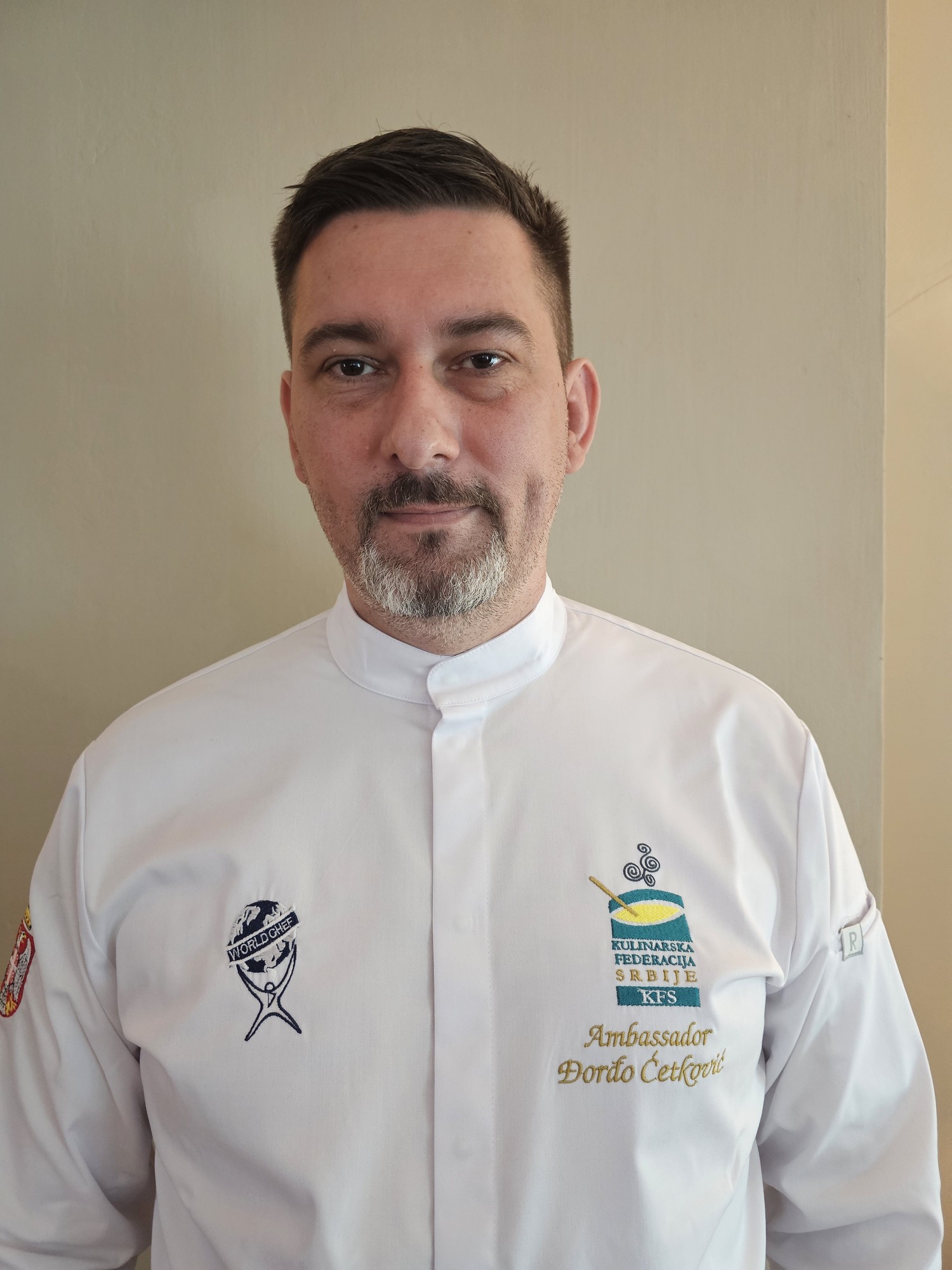
 Djordjo Cetkovic, Executive Chef at Pano Kato Grill, Pizza & Deli, in a chef's jacket embroidered with the Culinary Federation of Serbia (KFS) emblem and "Ambassador Djordjo Cetkovic".
By Djordjo Cetkovic
The first dish I ever cooked for guests was hunter's schnitzel with young beef, lovacke snicle sa junetinom, in 2003. I was born in Tuzla and grew up in Loznica, in western Serbia, and that plate was as Balkan as it gets. More than twenty years later I run the kitchen at Pano Kato Grill, Pizza & Deli, a Greek and Mediterranean restaurant operated by House of AnLi at Tanglin Mall. It is my ninth restaurant in about five years in Singapore, after kitchens including Zorba's (One Group), Hannibal at Robertson Quay, a small restaurant at the Botanic Gardens and The Black Hole Group.
Before Singapore I worked in Serbia, Austria, Switzerland, Germany and Portugal. People often ask me what transfers from Europe to Asia and what does not. My honest answer: the standard transfers; the way you teach it has to change.
Singapore moves fast. Cooks change jobs, new outlets keep opening, and a kitchen can lose a key person with little warning. You cannot stop that, so plan for it. Every station in my kitchen should have a written set-up: what must be ready, in what quantity, in which container, by what time. Every recipe has weights, not "a handful". Every plated dish has a reference photo. When someone new arrives, they learn the station from the document and from the cook beside them, not from memory and goodwill.
That sounds bureaucratic, but it is the opposite. It frees good cooks from guessing, and it protects the team when someone leaves. A strong number two matters as well. At Pano Kato my sous chef is Kenji, and my aim is simple: a plate should look and taste the same whether I am on the pass or he is.
Multinational teams are normal here. Language is rarely the real problem; unclear expectations are. I show the result, explain the reason and repeat it until it becomes habit. Telling a cook that a dish is "wrong" teaches nothing. Putting the reference next to it, tasting together and explaining why the sauce needs more acidity teaches a lot.
What I brought from Europe is not a style of food but a set of habits: mise en place finished before service, clean as you go, everything labelled and dated, first in, first out, and one voice on the pass. These habits are not cultural. They work in any kitchen, and most cooks embrace them once they see that service becomes calmer.
What I had to learn is the climate. Heat and humidity change everything. Dough behaves differently, so proofing and hydration need to be watched, not copied blindly from a European recipe. Herbs wilt faster, dairy and cut produce need tighter storage, and a cold room opened too often in the middle of service costs quality before it costs money. I prefer smaller batches prepared more often, and I check temperatures and textures throughout the day, not only in the morning.
The other lesson is humility. Imposing a European brigade system word for word on a Singapore team does not work. Explaining the purpose behind each rule, and adjusting the details to the people in front of you, does.
Heritage cooking, whether Balkan or Greek, depends on things that are easy to lose in a busy service: proper seasoning, patience with slow-cooked meat, and generous but balanced use of olive oil, lemon and herbs. My rule is to design every dish for the pass. If the team cannot reproduce it well on the busiest night, it is not ready for the menu, however good it tasted in testing.
In practice that means:
Knowing what you do not cook is part of a kitchen's identity too. Pano Kato does not cook river fish, for example. A clear, focused menu is easier to execute consistently than a long one that tries to please everyone.
Then there is the guest. Singapore diners are well travelled and curious, but their palates are not the same as those in Belgrade or Vienna. I do not dilute Mediterranean or Balkan flavours to make them "safe". Instead I pay attention to balance: brightness from lemon and herbs, contrast in texture, and salt that reveals flavour rather than announcing itself. The identity stays; the balance adjusts.
As Ambassador for Asia of the Culinary Federation of Serbia, I spend part of my time building connections between chefs and associations in Serbia and Asia. Attending the Worldchefs Congress & Expo 2024 here in Singapore reminded me how much chefs gain from talking across borders. The problems I have described, from staff turnover to consistency, are shared everywhere. The solutions are usually less glamorous than people expect: clear standards, patient training and discipline that the team understands, not merely obeys.
If I had one piece of advice for a chef moving from Europe to Asia, it would be this: bring your standards, leave your assumptions, and write everything down.
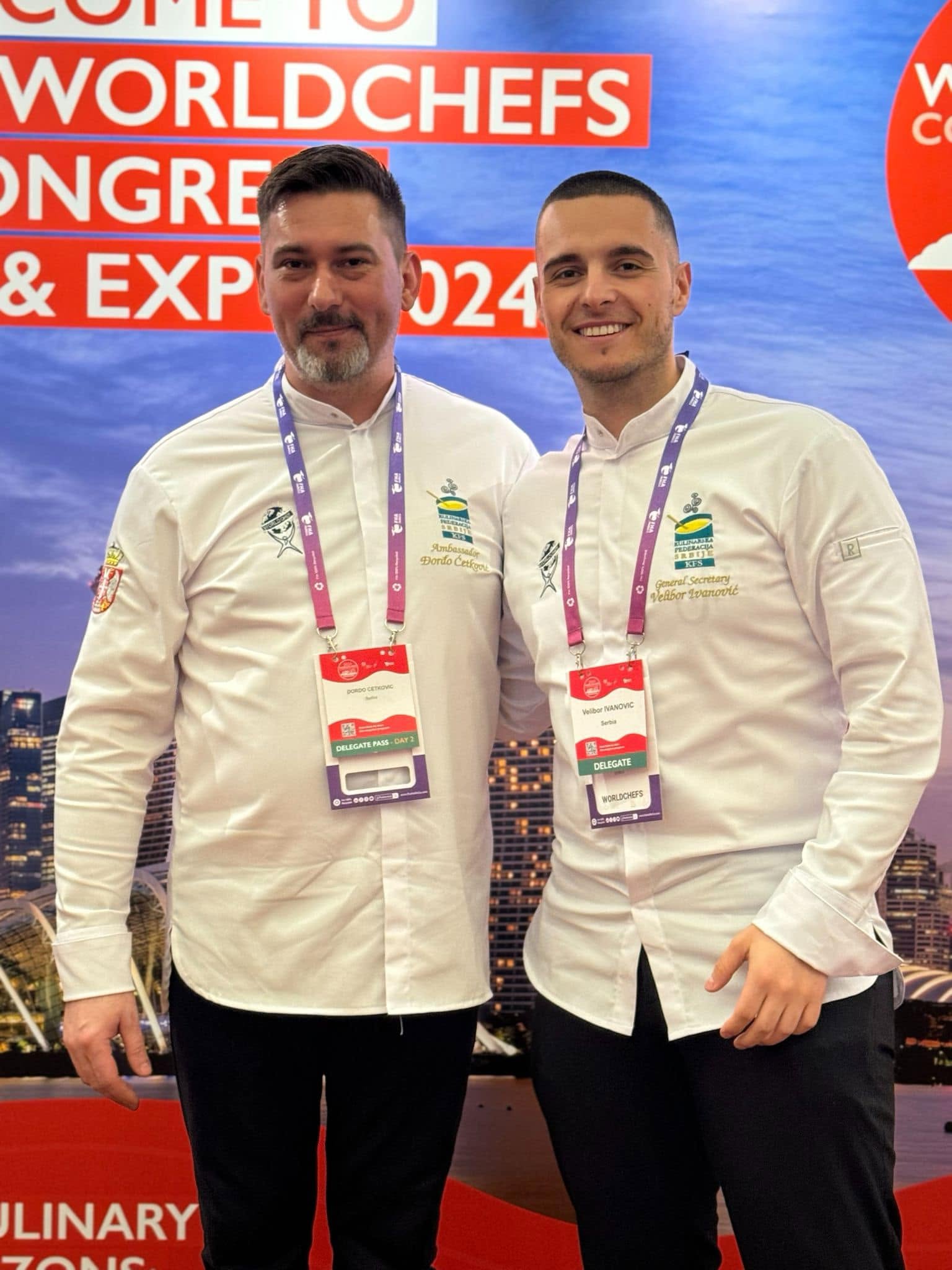
Djordjo Cetkovic (left) with Velibor Ivanovic, both in Culinary Federation of Serbia chef jackets and delegate passes, at the Worldchefs Congress & Expo 2024 in Singapore. |
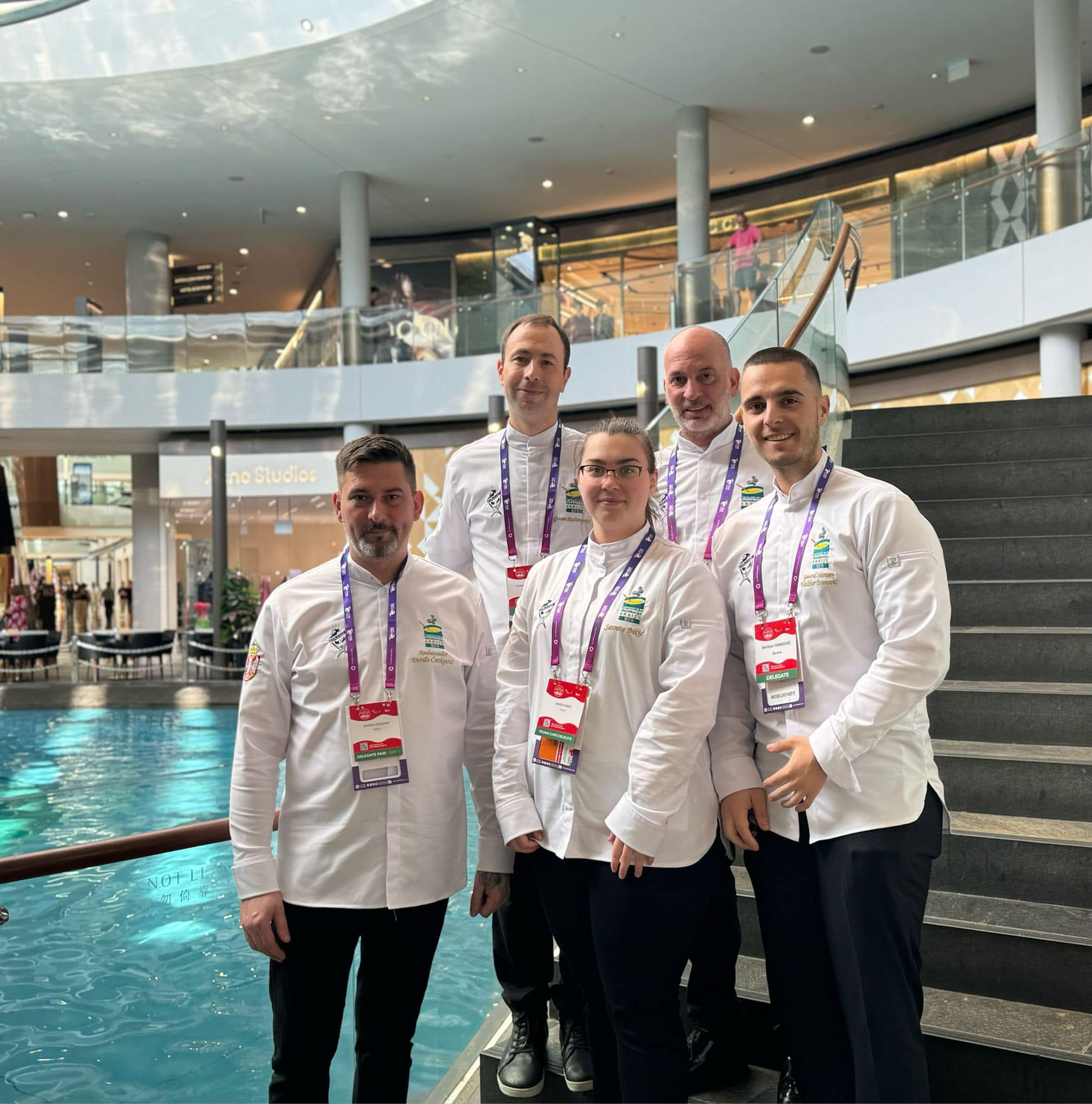
Djordjo Cetkovic (front left) with fellow chefs in Culinary Federation of Serbia jackets and Worldchefs 2024 delegate passes at Marina Bay, Singapore. |
About the author: Djordjo Cetkovic is Executive Chef at Pano Kato Grill, Pizza & Deli, the Greek and Mediterranean restaurant run by House of AnLi at Tanglin Mall, Singapore. Born in Tuzla and raised in Loznica, Serbia, he has worked in professional kitchens since 2003, in Serbia, Austria, Switzerland, Germany, Portugal and, for the past five years, Singapore. He is Ambassador for Asia of the Culinary Federation of Serbia.
Photos: personal archive of Djordjo Cetkovic

HCA is a premier business publication catering to hotels, food and travel industries worldwide. We provide extensive coverage to your products, events and services to the targeted customers.
The views expressed on this website do not necessarily reflect the views of the publisher.
Copyright © - All Rights Reserved - hotelsandculinaryasia.com